

Gardiner, in Montana, is the only town that has a drive-in entrance to Yellowstone, the entrance to Lamar Valley. It was here that wolves were reintroduced in 1995 and is considered the best place on Earth for viewing these wild animals. The winter months are the most popular times, running from about December to March. The snow causes the elk to descend, and hunting becomes more frequent and noticeable. A dark wolf can be seen easily be seen against the white snow, up to two miles away. The park boundary is only five minutes’ drive from the town, while Lamar is a 45-minute to one-hour drive away. The Roosevelt Hotel, which is located about a mile from the North Entrance, remains open throughout the winter. Reservations can be made directly at rhyellowstone.com.
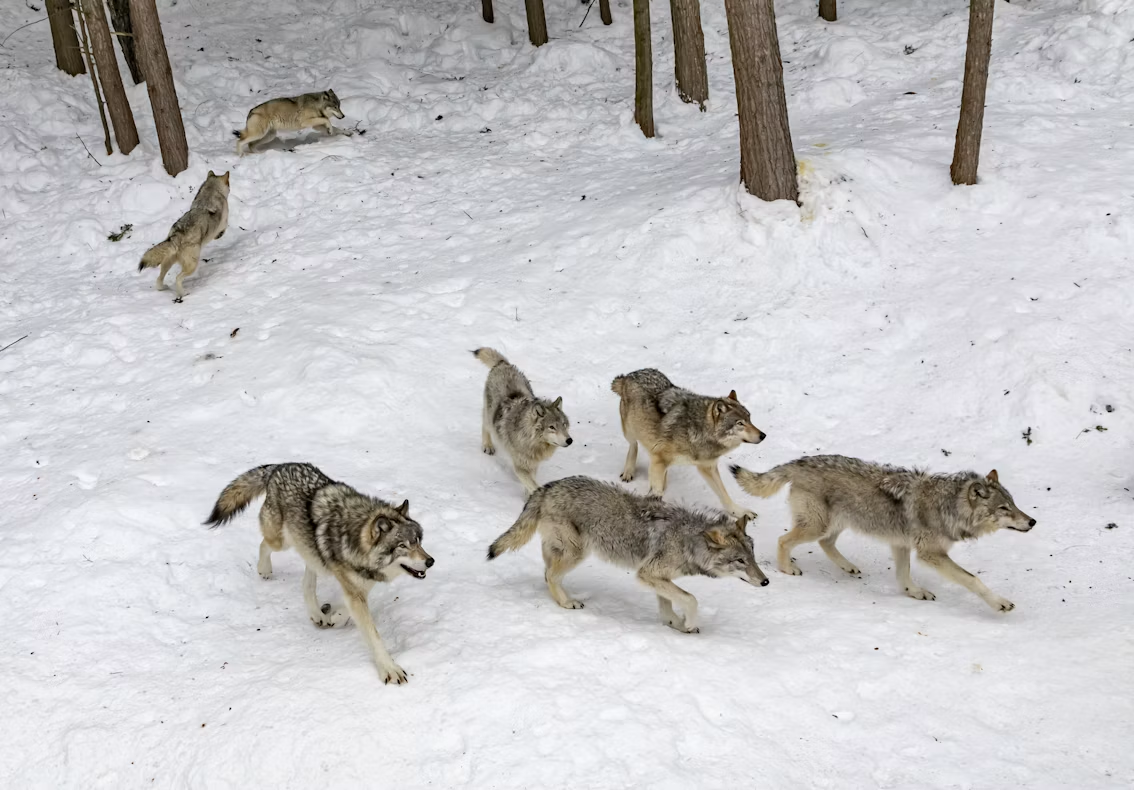
Eva Blue / Unsplush
When is the best time for winter wolf watching?
The best time is from December to March. The snow drives the elk into the lower valleys where they are easier to catch, which is why hunting takes place more frequently and in open areas. A dark wolf stands out clearly against the snow and can be seen through a scope at distances that summer grass would hide. During the day, the two hours around sunrise give the best results. You should be in the valley before the first light. Dusk also affords opportunities to see the wild wolves. The road from Gardiner through Mammoth and on past Lamar to Cooke City is the only section of Yellowstone’s interior that is plowed and accessible to normal cars throughout the winter. Everywhere else closes to vehicles until spring.
Where do you watch wolves, and how do you actually find them?
The Lamar Valley, which is in the northeastern part of the park and lies along US-212 between Tower Junction and Silver Gate, is the main area. It has long been known as America’s Serengeti and contains the Junction Butte and Lamar Canyon packs (and, in the past, the well-studied Druid Peak pack). The various pullouts that are productive have names that the regulars are familiar with, such as Slough Creek, Little America, the Hitching Post, the Lamar River Bridge, the Footbridge Pullout at the confluence of the Lamar and Soda Buttes, and Hellroaring Overlook further west.
Wolf watching continued to be popular earlier this year, even though the total number of wolves is low with fewer than 84 wolves in Yellowstone. The lighter snowpack has prevented the elk and bison from moving down to lower elevations, so the wolves haven’t had to travel far to find food, which has made packs such as Junction Butte and Rescue Creek easier to spot. The latest status of the packs for 2026, include; Rescue Creek has 16 wolves, ranging from Blacktail Plateau to Tower Junction. Junction Butte, the park’s most-watched pack, consists of 15 wolves. Bliss Pass is a newer pack with 6 members. Eight Mile has 17 wolves situated near Blacktail Plateau and Gardiner, and sightings for this pack have been kept secret for the sake of the animals’ safety. Wapiti Lake has 18 or more wolves, holding the Hayden Valley but ranging widely this winter. Although the pack lost all its pups this year to canine distemper. Mollies, one of the oldest packs, numbers about 7 wolves in Pelican Valley. Cougar Creek is estimated at 4 wolves in the Gallatin Mountains. And the 1470F group has just 2 wolves, them being descendants of the once-famous alpha wolf from Junction Butte, 907F.
If you are new to spotting wolves, look for scopes rather than the wolves. If you see a group of people using spotting scopes on tripods along a pullout, stop your vehicle. The wolf-watchers are truly kind and will tell you which pack you’re viewing, the number of animals in it, and whether a well-known individual is present. Sightings are generally made from half a mile to two miles away, so having a scope mounted on a stable tripod makes the difference between seeing just a moving dot and seeing a wolf. It’s a good idea to have 8–10x binoculars close to your neck so that you can use them to scan first before settling on the scope. Wolves were reintroduced to the area in 1995, the Yellowstone Wolf Project has been tracking these families ever since, and if you’d like to know the name the wolf you’re watching the Mammoth visitor center sells a wolf ID chart.
What gear do you need, and can you rent it?
You must have a spotting scope and a tripod, warm clothing suitable for temperatures below zero, and the patience to spend long periods in a stationary position. The binoculars are used for scanning. It’s not necessary to purchase a spotting scope for a single visit. At Optics Yellowstone in Gardiner, high-quality spotting scopes and binoculars can be rented close to the North Entrance, and the general store in Silver Gate which is only a few minutes’ drive from Lamar. You can rent scopes for about $50 a day and binoculars for about $20. Reservations should be made in winter. Be aware that sightings are by no means guaranteed. These are wild animals that cover enormous areas. The factors that improve your chances are arriving in place before dawn and having a guide who knows where the packs spend the night and who has professional optics.
Getting there from Gardiner
The park boundary at the North Entrance and Mammoth is about five minutes’ drive from town and then another 45 to 60 minutes east to get to Lamar. Since that is the only road that is cleared for vehicles in winter and the best time to travel is before daybreak, there is no reasonable way to commute from a distance. You have to base yourself at the North Entrance and drive in the dark. If you prefer, guided snowcoach and wildlife tours are available from the Gardiner area with another person driving the ice for you.
| At a glance | |
| Season | ~December – March (dawn is prime) |
| Where | Lamar Valley and Northern Range pullouts, US-212 |
| From Gardiner | Park boundary ~5 minutes · Lamar ~45 min–1 hour |
| Why Gardiner | Only year-round drive-in entrance; the Lamar road is plowed |
| Gear | Spotting scope and tripod; sub-zero layers (rentals in Gardiner/Silver Gate) |
Frequently asked questions
What else is out there in winter?
On the same road you can see bison pushing the snow off the grass in order to get at it, bighorn sheep on the canyon walls above the Gardner River, bald eagles searching the water, and coyotes running across the flat areas. By March, as the snow becomes softer, the first grizzlies coming out of their dens, occasionally challenging a wolf’s kill. The Northern Range in winter is the quiet that feels most alive of any you’ll encounter in the Lower 48.
Where to stay for winter wolf watching
The Roosevelt Hotel, located about a mile from the North Entrance. It is effectively the starting point for the sole winter road leading into Lamar. It’s proximity means that you don’t have to drive for an hour along a dark highway before you even start. A pre-dawn departure simply involves a short journey to the boundary. It is one of Gardiner’s more recent hotels, owned by women and with strong local ties, offering 75 rooms and five cabins. The majority of the rooms have a view either over the Yellowstone River or across the park. Moreover, the hotel remains open right through the winter wolf season, actively accommodating visitors who are coming for the cold weather.
As a guest staying at The Roosevelt, you get free coffee and pastries to take with you as you leave while it’s still dark. You also have free parking so that you don’t have to clear another person’s parking space at five in the morning.
Please book directly: https://rhyellowstone.com
Frequently asked questions
Yes, the road from Gardiner through Mammoth to Lamar and on to Cooke City is plowed and open to motor vehicles all year round. It is, in fact, the only one of the interior roads in Yellowstone that is well maintained during the winter months.
Before the first ray of light appears. The two-hour period surrounding sunrise is the best time, dusk being the next best option.
Yes. Wolves are generally about half a mile to two miles away. Scopes can be rented in Gardiner (at Optics Yellowstone) or Silver Gate.
It is not necessary, but having a guide who knows the current locations of the packs and is equipped with professional optics greatly increases your chances, particularly at dawn.
Be prepared for temperatures to be well below zero at dawn and wear heavy insulated layers, and bring hot drinks to keep you warm.
Slough Creek, Little America, the Hitching Post, the Lamar River Bridge, the Footbridge Pullout, and Hellroaring Overlook.
Gardiner, at the North Entrance. It’s about 45 minutes to an hour from the valley and the only year-round drive-in town.